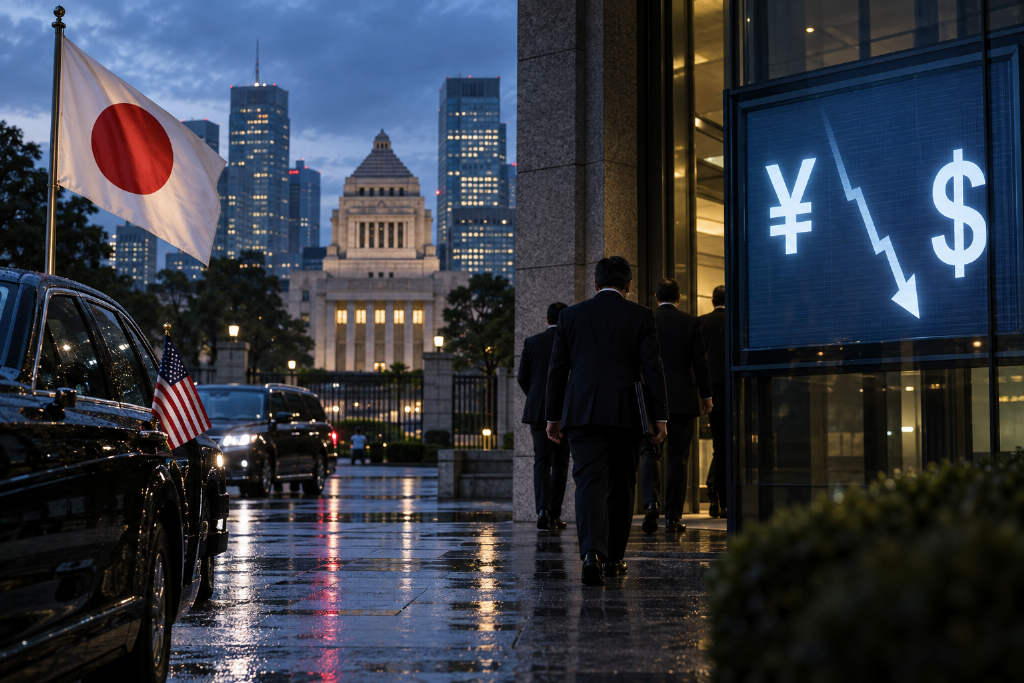
Policy Regula2026-09-25 15:57:59Japan says it will stay in close contact with the U.S. on FX after Trump raises concern over yen weaknessJapan Finance Minister Katayama Satsuki said on Sept. 25 that U.S. President Donald Trump raised concerns about the yen’s depreciation during a meeting this week with Japanese Prime Minister Sanae Takaichi. Takaichi responded that an undervalued yen is a problem. Katayama said Japan will continue close communication with U.S. Treasury Secretary Bessent on a range of issues, including foreign exchange. After the remarks, the yen briefly rose 1.1%, while the dollar fell to around 156.98 yen. Katayama also said specific monetary policy tools are decided by the Bank of Japan, adding that the central bank should implement appropriate policy while staying in communication with the government. She said the Japanese government would not hesitate to take bold action. Market participants said the latest comments still amount mainly to verbal policy signaling, while the Japan-U.S. rate gap and the Federal Reserve’s rate path remain key drivers for the yen.320
Bank of Japan2026-09-21 12:52:19BOJ Rate Hike Has Not Yet Triggered a Broad Yen Carry Trade UnwindThe Bank of Japan raised rates in September as expected, but the move fell short of the market’s more aggressive expectations, easing immediate fears of a repeat of the 2024 yen carry trade unwind. The article argues that a disorderly reversal usually needs three forces to hit at once: higher yen funding costs, a rapid appreciation in the yen, and weakening returns on dollar assets such as U.S. stocks and Treasuries. For now, those conditions have only shifted at the margin rather than lining up in full. BOJ Governor Kazuo Ueda did not rule out consecutive rate hikes at his post-meeting press conference, yet he also left the pace of tightening unclear. At the same time, the external backdrop has not turned sharply negative. U.S. August nonfarm payrolls were described as steady, oil prices moved lower, Asia-Pacific equities rose broadly, and the yen weakened further after the rate decision. The piece also points to positioning data as a reason the near-term risk looks more manageable. After joint U.S.-Japan intervention, yen shorts were covered in size. As of the week of Sept. 15, CME non-commercial yen short positions were down about 56% from the late-July peak, while long positions had jumped 135%, with net long positioning moving out of negative territory in September. The report says the key risk to watch now is not the BOJ alone, but a tail event in U.S. assets that could force a sharper and more concentrated unwind.550
USDJPY2026-09-21 14:56:02USD/JPY rises above 157.5, up 0.4% from the previous session closeOdaily reported, citing data from Gate, that the U.S. dollar against the Japanese yen (USDJPY) moved above 157.5. The pair was quoted at 157.506 at the time of the update. Based on the figures provided in the brief, USDJPY was up 0.4% compared with the close of the previous trading session. The update was published as a 7x24 market flash and did not provide additional context beyond the quoted level and percentage change.380
Policy Regula2026-09-19 13:48:08Next Week’s Macro Watch: Trump’s Middle East Decision, Yen Intervention Risk, and Fed AftershocksGlobal markets are set to spend next week absorbing the fallout from the Federal Reserve’s first rate hike since 2023, while repricing a higher-for-longer path for interest rates. On the geopolitical front, Trump is expected to meet Gulf states during the United Nations General Assembly in New York and is said to be nearing a “major decision” on whether to escalate strikes on Iran. In Saudi Arabia, air defense sirens were heard again in the capital after several months, leaving oil markets caught between a geopolitical risk premium and signs of supply recovery. In Japan, the Silver Week holiday is likely to thin liquidity just as the yen remains under pressure, lifting expectations for possible policy intervention. The week’s calendar also includes a series of U.S. Treasury auctions and speeches from several Federal Reserve officials, alongside the European Central Bank’s economic bulletin and final September readings for U.S. consumer sentiment and one-year inflation expectations.420
Japanese yen2026-09-18 15:49:29Nikkei says yen jumped overnight as BOJ conducted rate checksThe Japanese yen rose sharply in overnight foreign-exchange trading from late Sept. 18 to early Sept. 19, Japan time, according to Nikkei. The report said the currency briefly strengthened to the upper 156-yen range against the U.S. dollar. During the same period, the Bank of Japan carried out what the report described as a "rate check," asking market participants about exchange-rate levels. Nikkei said such checks are widely seen as a preparatory step before possible foreign-exchange intervention. That, in turn, lifted market alertness over the possibility that Japanese authorities and the central bank could step in to buy yen and sell dollars.560
USD/JPY2026-09-15 08:09:25USD/JPY Breaks Above 155, Reaches One-Week HighUSD/JPY moved higher on Sept. 15 and broke above the 155 level, according to a BlockBeats flash update. The pair was up 0.44% on the day at the time of the report. BlockBeats said the move pushed the exchange rate to its highest level in a week. The update focused on the intraday move and did not provide further market details beyond the level break, the daily gain, and the one-week high.620
QCP2026-09-10 08:34:19QCP says yen strength, firm jobs and energy shocks are testing the Fed’s path this yearQCP said in its Sept. 10 macro thematic report that the recent rise in the yen, resilient U.S. labor data and lingering energy-driven inflation risks are complicating the Federal Reserve’s policy outlook for the rest of the year. The report said the yen moved quickly from around 160 to around 154, driven by Bank of Japan policy normalization, carry trade unwinds and a weaker U.S. dollar. It also pointed to Japan’s August foreign exchange reserves falling by $87.8 billion, with securities holdings down by the same amount, which QCP said may be tied to funding arrangements for yen intervention. On inflation, QCP argued that the spring jump in PCE inflation was mainly pushed by energy prices. It noted that non-durable goods contributed about 0.85 percentage points to the year-over-year rise in core PCE from February through May, while energy alone contributed about 0.89 percentage points. By July, that energy contribution had fallen to 0.48 percentage points, but core PCE still stood at 3.3%. QCP added that strong August payrolls and constrained shipping through the Strait of Hormuz keep the Fed’s year-end policy path under pressure.870
Goldman Sachs2026-09-10 04:16:46Goldman Sachs says a shift by Japan’s pension giant into domestic bonds could lift the yen and ripple across Asian FXGoldman Sachs said in its latest report that the yen has gained more than 4% since early September, with a more hawkish Bank of Japan and market expectations around a possible asset allocation shift by Japan’s Government Pension Investment Fund, or GPIF, prompting investors to reassess the currency’s medium-term path. The bank said that if GPIF were to move part of its portfolio from overseas assets into domestic fixed income, the yen could see a structural appreciation. Using GPIF’s roughly $2 trillion in assets under management, Goldman estimated that a 5 percentage point increase in domestic fixed-income allocation would theoretically translate into about $100 billion of USD/JPY selling. The report said that size is roughly equal to half of Japan’s annual current account surplus and could also trigger an unwind of previously built yen-funded carry trades. Goldman added that the effects could spill into broader Asian currency markets. Looking at data since 2022, the bank said the Korean won has been the most sensitive to moves in the yen, with a beta of about 0.45, followed by the Thai baht and the Malaysian ringgit. Offshore yuan and the Taiwan dollar were also cited. Goldman kept its view favoring the Taiwan dollar over the yuan in North Asia, and in South Asia it maintained a bearish stance on the Philippine peso and a constructive view on the Indian rupee versus the peso. The bank noted that a GPIF reallocation into domestic bonds remains a scenario analysis, not a formal decision.1110